8 Myths About Hyper-Casual Support And Why They Are Wrong
Why "No Support" is Quietly Killing Your Hyper-Casual Revenue
The hyper-casual playbook says: ship fast, kill fast, repeat. In that context, support is an easy thing to deprioritize — the economics don't seem to add up, and the pace doesn't leave room for it. But the "no support" decision has a hidden cost that compounds quietly: in churn you can't attribute, ratings you can't recover, and chargebacks you didn't see coming.
The good news is that AI has changed the equation entirely. This isn't about building a support team anymore. It's about deploying a lightweight automated layer that protects your margins without slowing you down.
Below, we break down the eight arguments studios use to justify skipping support and why, with AI in the picture, none of them hold up the way they used to.
1. “Our game is simple. Players won’t need support.”
The Assumption: Hyper-casual is intuitive by design. We tell ourselves that if a player hits a wall, it’s usually an intentional friction point (like ad frequency) not a bug that requires a support query.
The Reality: Simplicity isn't a shield against technical issues. Even a one-tap game can suffer from broken rewarded videos, IAP failures, or device-specific crashes. These problems are retention killers that hit your most engaged players the hardest. When a player can't find a fix, they don't wait; they head straight to the App Store to leave a 1-star review.
The Fix: Triage by Impact
-
The Heat Map: Use AI to scan reviews and emails, surfacing the top 10% of recurring issues. This gives your devs a real-time heat map of what is actually breaking.
-
The Auto-Triage: Deploy an AI system to handle common fixes. For instance, if a player reports a crash on a specific phone model, the AI can immediately suggest a cache reset. If the issue can't be resolved technically (or if it's a known bug), it automatically grants a bonus of in-game currency as compensation instead.
2. “We monetize with ads. Support will break our unit economics.”
The Assumption: If your game makes $0.10–$0.20 per user, paying $6 for a human to answer one email is a non-starter. In the high-volume, low-margin world of hyper-casual, the maths doesn't add up.
The Reality: "No support" is the expensive choice. You pay for it through players who quit, refund requests, and bad ratings that make your ads more expensive to run. Besides, AI changes the maths. It turns support into a tool to keep players and make more money. Take a game with 10 million installs and a $0.15 ARPU. If poor technical experience is driving even 1% of players to churn earlier than they otherwise would — that's 100,000 players. If each of those players would have generated just one more day of ad revenue before leaving, you're looking at $15,000 in recovered revenue from a single retention nudge.
The Fix: The Profit-Positive Model
Instead of a "help desk," think of AI support as a monetization feature with two main functions:
-
The Lean Stack: Use AI to handle 95% of your ticket volume. While there is a cost for the technology, it is a fraction of the cost of human labour. By batching the remaining 5% of complex issues for a 30-minute weekly human review, you keep your overhead low, predictable, and scalable.
-
The Revenue Rescue: The AI can also help you recover lost revenue. When the bot detects a player is frustrated or a technical error has occurred, it triggers a "Value Recovery" offer. For example, “Sorry that level didn't load right! Watch this quick video and I’ll give you a free Power-Up to make up for the trouble.” This turns a moment of friction into a new ad impression, making the support interaction pay for itself while keeping the player in the game.
3. “By the time we set up support, the game is already dead.”
The Assumption: Hyper-casual moves at breakneck speed. If a prototype has a two-week window to prove its worth, spending time on support feels like a distraction from the next big hit.
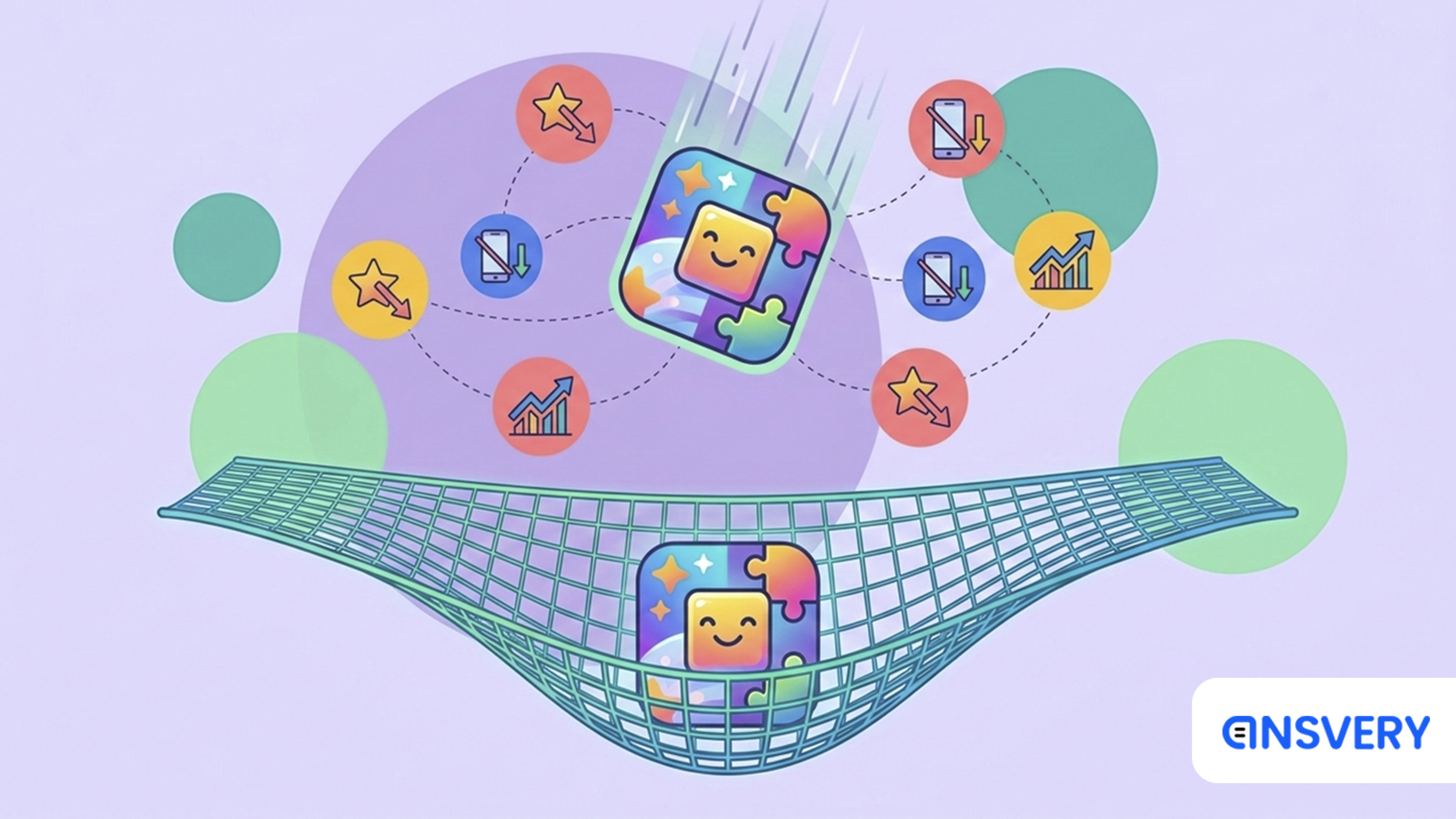
The Reality: You aren't building support for one game, you’re building it for your entire portfolio. Without the support safety net ready on day one, you risk killing your hits before they can scale. According to Newzoo's Global Games Market Survey, 93% of players cite in-game lagging as a reason they remove games from their phones — the single most common uninstall trigger, ahead of competitive imbalance, paywalls, and toxic players combined. Most of them never report it. They just leave, and their silent exit shows up as an engagement drop you can't explain. Without a safety net to catch and identify those moments, the rating damage accumulates quietly until your CPI becomes too high to sustain — and you end up killing a game that could have been a winner.
The Fix: Portfolio-Wide Automation
-
The Portfolio Template: Treat AI support as a reusable software component, just like your analytics SDK. Once you build an automated workflow for one game, it becomes a plug-and-play template for every title you launch. The AI can correctly identify which game a player is contacting about, even across a portfolio of a dozen titles, so a single deployment covers everything you've launched and everything you will launch. [See how Freeway Games did it →]
-
The Universal Bot: This means every prototype gets a 24/7 safety net from day one, giving you the data to back the winners without burning time on the ones that won't scale
4. “We’re a small team. We don’t have time for tools.”
The Assumption: Selecting and managing a support stack feels like a massive loss of time. When you’re a team of three, you’d rather spend your hours on the next build than on a complex help desk.
The Reality: The absence of tools doesn’t eliminate the work but simply scatters it. Without a system, you’re forced into "manual firefighting": jumping between messy emails, App Store reviews, and social media DMs. It drains your team's focus more than a simple tool ever would.
The Fix: Lightweight AI Integration
-
The Drop-In Agent: Modern AI support tools are designed to slot into your existing workflow. You can use AI-powered agents right inside your existing email. These tools can automatically draft replies and categorize tickets (e.g., “Refund” vs. “Bug”) with zero manual effort, ensuring that your hours are spent on product iteration. Here's what that looks like in practice:
-
The Managed Solution: Freeway Games was running support from a single email inbox and had no bandwidth to evaluate and implement a complex help desk. Instead of off-the-shelf tools, they got a custom AI agent built and maintained for them — response times improved 7× with no new hires and no added complexity. [Full case study →]
5. “Analytics already tells us what’s wrong.”
The Assumption: Dashboards track every crash and drop-off point. If a major issue exists, it’ll show up in the metrics. Support is just an echo of the data we already have.
The Reality: Analytics show the what, but support reveals the why. Your data might show a 40% drop at Level 5, but it won't tell you the reason. Is the level too hard, or is an unintentionally fast timer making it impossible? Qualitative context is the difference between a lucky guess and an effective fix.
The Fix: Automated Qualitative Analysis
-
The Trend Alert: If AI flags that 40% of queries mention "can’t pass level 3 whatever I do", you have a specific lever to pull to increase retention.
-
The Early Detection: During soft launch, AI can surface an impactful issue (for example, that players find "controls too sensitive") within days, so you can adjust the mechanics quickly and based on real feedback.
6. “Store reviews are our support channel.”
The Assumption: Players voice their complaints publicly anyway. We can just react to them in the store and solve the issues there.
The Reality: Once a negative review is posted, the damage is done. Treating the store as a help desk is a recipe for a "rating death spiral":
79% of users check reviews before downloading. Public complaints act as a "keep out" sign.
If reviews drag you below 4 stars, your conversion rate can plummet by 50%.
Low ratings signal "low quality" to algorithms, burying your game in search results.
The Fix: In-App Interception
-
The Intercept: Use an in-app AI bot to give frustrated players an immediate, private place to vent and get a resolution.
-
The Review Rescue: Responding publicly to a 1 or 2-star review with empathy and a private resolution link does two things at once: it gives the detractor a reason to reconsider, and it signals to every future reader that you take players seriously.
7. “AI is risky. It can give wrong answers.”
The Assumption: Generic chatbots can hallucinate or mishandle sensitive player issues, creating more PR problems than they solve.
The Reality: The risk isn't "AI", it’s unconstrained AI. While open-ended models can wander off-track, a purpose-built AI is constrained at every level: it draws only from a structured, verified knowledge base rather than the open web; its responses are bounded by workflow logic that defines exactly what it can and can't do; and its tone is calibrated to match your brand voice. It can't hallucinate an answer it doesn't have — it escalates instead.
The Fix: Guardrailed AI
-
The Rule-Follower: A constrained bot handles tickets like "My rewarded ad didn't credit" because it follows a pre-approved technical script.
-
The Handoff: If the AI encounters a high-risk query (like "Someone hacked my account"), it doesn't improvise. It instantly identifies the intent and hands it off to a human.
8. “Formal support invites legal headaches.”
The Assumption: A support channel is Pandora's box. It invites complex requests for data deletion (GDPR) and refunds, creating a "liability trap" for a lean team.
The Reality: A formal support channel doesn't create new legal obligations — those already exist whether you have a support inbox or not. What it does is give you control over how they're handled. An undocumented chargeback dispute or an ignored GDPR deletion request is far more legally dangerous than a structured, logged interaction.
The Fix: The AI "Compliance Firewall"
-
The Privacy Shield: A bot can recognize a "delete my data" request, trigger a secure verification process, and execute the deletion with a legal receipt – all without a human lifting a finger.
-
The Refund Buffer: For refund requests, AI can instantly provide official dispute links for Apple or Google. This ensures you stay compliant while steering players away from damaging chargebacks.
Conclusion: From "Cost Center" to "Software Feature"
The argument isn’t that hyper-casual studios need to adopt traditional, slow-moving support models. In a high-velocity market, that would be tricky. Instead, we can recognize that AI and automation have redefined support as a Software Feature.
When you treat support as an automated layer of your game’s infrastructure, it transforms from a human labour cost into a multi-functional tool:
-
A Silent Bug Detector: It catches the technical issues your analytics can't see — broken rewarded ads, device-specific crashes, IAP failures — before they reach the App Store.
-
A Monetization Lever: It identifies frustrated users in real-time and converts that friction into ad revenue through rewarded "value recovery" offers.
-
A Portfolio Safety Net: Once deployed, it scales across every title you launch automatically, giving you a 24/7 triage layer for every prototype without rebuilding anything from scratch.
-
A Real-Time Analytics Engine: It provides the "why" behind the "what," identifying exactly why a level is failing or a control scheme is being rejected within days of launch.
-
A Defensive PR Tool: It intercepts negative sentiment before it reaches the App Store, protecting your star rating and keeping your CPI low.
-
A Compliance Firewall: It handles the complex legal requirements of GDPR and refunds on autopilot, protecting your developer account without manual overhead.
For a genre built on extreme efficiency and massive scale, the most strategic move is no longer to ignore the player. The competitive edge belongs to the studios that deploy intelligent automation. By converting player friction into data, revenue, and retention, all while staying within the tight unit economics of the business, you aren't just solving tickets. You’re building a more resilient, profitable portfolio.